
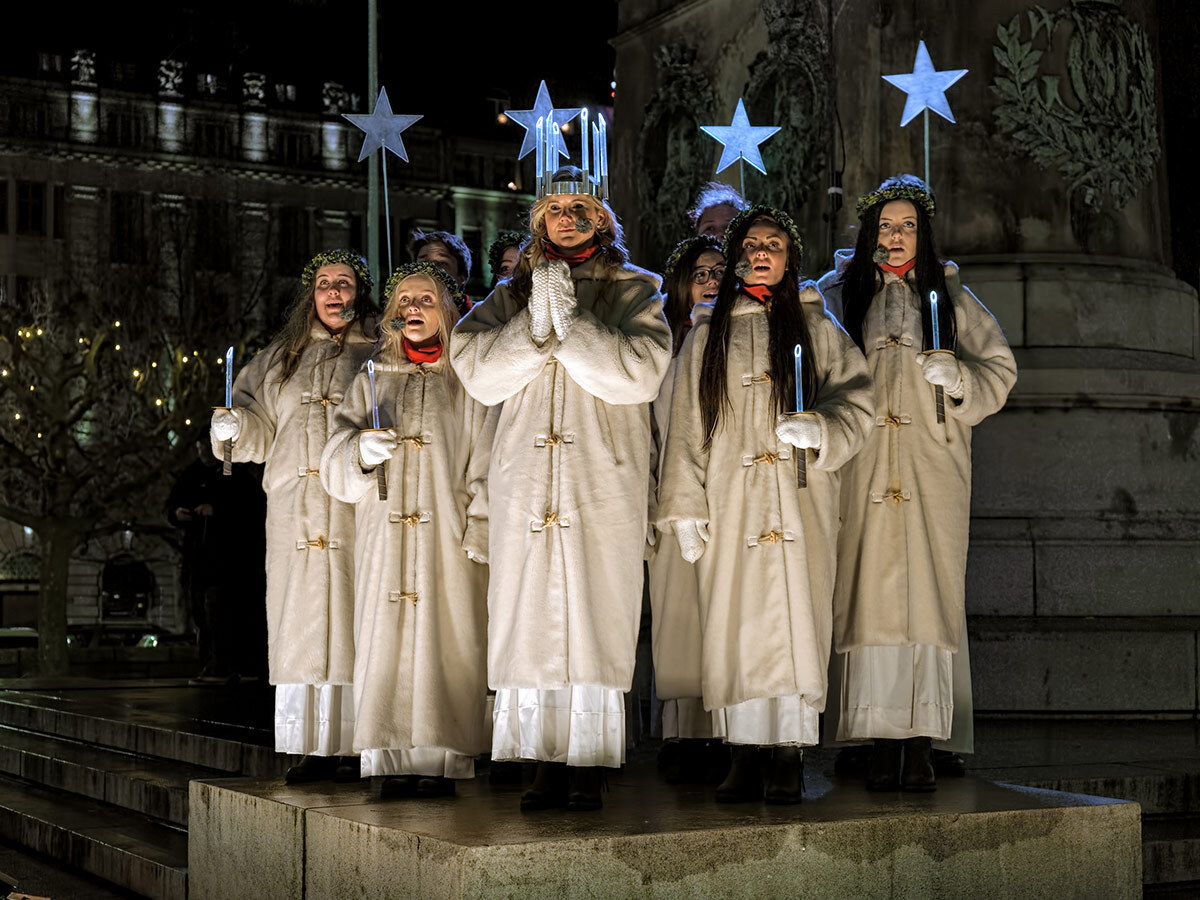
 On the morning of 13 December, in schools and churches and offices across Sweden, the lights go out. A procession comes in singing — a girl in a white gown with a red sash and a crown of live candles, followed by attendants carrying single candles in the dark. It happens before dawn, because that is the point of it.
Who Lucia actually was
Lucia of Syracuse was a Sicilian Christian who was killed in the year 304, during the persecutions under Diocletian. Not medieval — late Roman, and about as far from Sweden as the Mediterranean gets. Her name comes from the Latin lux, light, and it is that coincidence of name and season which carried her all the way north.
Why the thirteenth of December
Because it used to be the longest night of the year.
Under the old Julian calendar, 13 December fell on or about the winter solstice. A saint whose name meant light, whose feast day landed on the darkest night of the year, in countries where December is barely lit at all — the fit was too good to lose. When Sweden moved to the Gregorian calendar in 1753 the true solstice slid to around the 22nd, but Lucia stayed put on the 13th.
So the date no longer marks the astronomical event that made it meaningful, and nobody has ever seriously suggested moving it. It is still the day the light comes back.
The Swedish legend
Alongside the Sicilian saint there is a homegrown story. During a famine, so it goes, a ship appeared on Lake Vänern carrying food — and at its prow stood a woman in white with a crown of light, who came ashore in Värmland and fed the starving.
The two Lucias have long since merged. The procession is the Sicilian martyr, and the arrival out of the dark with something to eat is very much the Swedish one.
Lussekatter, and the cats in the name
The buns handed round on Lucia morning are lussekatter — literally "Lucia cats." They are saffron buns, deep yellow, rolled into an S with a raisin set in the curl of each spiral, and the shape is said to be a sleeping cat.
There is a darker reading of the name, which is that the cat belonged to the devil, and that saffron — costly, golden, thought to carry a power of its own — was what kept him off. Whether or not anyone believed it, the recipe stuck: saffron is still what makes a lussekatt a lussekatt, and it is not a cheap way to make a bun.
They are eaten with glögg, or coffee, and usually with gingerbread alongside.
Keeping Lucia
Every Swedish town picks a Lucia. So do schools, workplaces, parishes and the national broadcaster, and the processions run all morning through the middle of December — one of the few traditions in the country that everyone still turns out for.
For celebrating it at home, our Lucia collection has crowns, candle holders and decorations for the day, with more in candles, candle holders and candle rings, and the baking and glögg in Scandinavian treats.
Lucia sits in the middle of Advent — there is more on the season in our history of Advent, and the rest of the traditions in Scandinavian lore, including the tomte and the Julbock.